Wheel Balancing: What It Does, What It Costs, and When You Actually Need It
What wheel balancing does, the signs a wheel is out of balance, other causes of vibration, and roughly what balancing costs and how long it takes.
Updated 20 November 2026 · 12 min read · By FindMechanic

Need a tyre shop in London?
Compare tyre shops near you by Google rating and number of reviews, then call them direct. Free, no sign-up.
If your steering wheel starts shaking at around 60mph but settles down when you change speed, an out-of-balance wheel could be the cause. It’s one of the cheaper problems a tyre fitter can usually put right.
Wheel balancing involves adding small weights to a wheel rim so the complete wheel and tyre assembly rotates evenly. If a weight falls off, or a tyre is fitted without being balanced correctly, you may feel vibration through the steering wheel, seat or floor.
But not every vibration means you need wheel balancing. A damaged tyre, buckled rim or worn suspension component can feel remarkably similar.
Here’s how to recognise the difference, what balancing costs and when it’s worth having your wheels checked.
What Wheel Balancing Actually Is
Wheel balancing corrects uneven weight distribution around a wheel and tyre assembly by adding small weights to the rim.
Even a brand-new tyre and wheel aren’t perfectly uniform. One section may be slightly heavier than another because of natural variations in the rubber, wheel construction or fitted components.
Once the wheel starts spinning, those small differences create forces that can cause vibration.
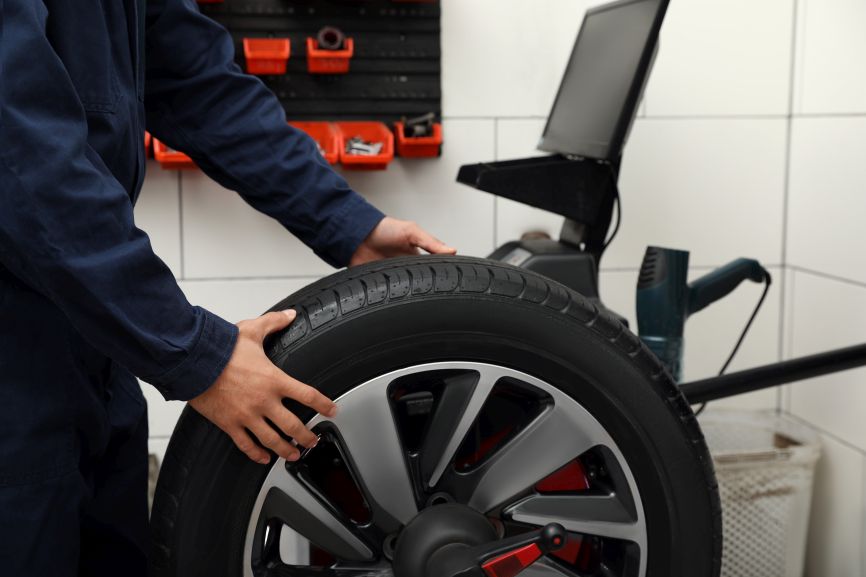
A tyre technician removes the wheel from the vehicle and places it on a computerised balancing machine. The machine spins the complete assembly, identifies the imbalance and calculates where corrective weights should be fitted.
These weights may be clipped onto the wheel rim or attached to its inner surface using adhesive strips.
The differences being corrected can be surprisingly small.
According to Continental on balancing tyres, an imbalance of just 10 grams can produce a force equivalent to roughly 2.5kg at 60mph.
That’s why something as small as a missing balancing weight can make a steering wheel shake noticeably at higher speeds.
The tyre valve itself also contributes weight to one part of the wheel. Combined with natural variations in the tyre and rim, this explains why a newly fitted tyre needs balancing rather than simply being assumed to rotate evenly.
Balancing is performed on the complete assembly, not the rubber alone. If you’re unsure which replacement tyre fits your wheels, our guide explains how to read your wheel and tyre size.
How You Know a Wheel Is Out of Balance
The most recognisable symptom is vibration that appears at a particular road speed and changes as you accelerate or slow down.
You might drive around town without noticing anything unusual, then join a faster road and feel a tremor through the steering wheel.
The vibration may become stronger around 50–70mph before reducing again at a different speed. It won’t necessarily disappear completely.
Where you feel the movement can provide another clue.
Vibration through the steering wheel
If the steering wheel shakes or trembles while you’re travelling at a steady speed, one of the front wheels may be out of balance.
The vibration might be slight at first but become more noticeable as the vehicle reaches a particular speed.
However, a steering wheel vibration doesn’t automatically confirm a front-wheel balance problem. A damaged tyre, distorted rim or worn steering component can produce similar symptoms.
Vibration through the seat or floor
When a rear wheel is out of balance, the vibration may be more noticeable through the seat, floor or body of the vehicle.
You might feel a repeated buzzing or shaking sensation even though the steering wheel remains relatively steady.
This front-versus-rear distinction can help a technician decide which wheels to inspect first, although it isn’t a reliable diagnosis on its own.
Unusual tyre wear
A persistent imbalance can contribute to irregular or patchy tread wear, sometimes described as cupping or scalloping.
Instead of wearing consistently, parts of the tread may develop shallow dips or uneven patches.
But tyre wear has several possible causes. Incorrect pressures, worn shock absorbers and other suspension problems can create similar patterns.
Feathered tread wear, in particular, is more commonly associated with wheel-geometry problems than simple imbalance.
More vibration or road noise
You may also notice that your car feels rougher or noisier than before.
An unbalanced wheel can contribute to vibration and tyre noise, although road surface, tread condition and wheel bearings can also affect what you hear.
The most useful information is when the vibration started, the speeds at which it occurs and whether you’ve recently changed tyres or hit a pothole.
Those details are often more valuable than trying to diagnose the problem yourself.
When the Vibration Isn’t a Balance Problem
Wheel balancing is a sensible first check for certain speed-related vibrations, but it isn’t a cure for every shaking steering wheel.
Some problems can be corrected with a replacement balancing weight. Others require a wheel repair, new tyre or mechanical inspection.
Knowing the difference can save you money on work that won’t solve the problem.
1. A balancing weight has fallen off
This is one of the simplest possibilities.
Small balancing weights can become detached through corrosion, poor adhesion, previous fitting issues or impacts.
If a weight falls off, the wheel loses some of the correction originally made by the balancing machine.
You may notice a vibration that wasn’t there before, particularly at higher road speeds.
Sometimes there’s a visible clean patch or adhesive residue on the rim where the missing weight was positioned.
What it needs: A technician can check the wheel on a balancing machine and fit new weights in the correct positions.
The wheel should be measured again rather than simply replacing a missing weight with one of the same size.
2. A buckled wheel rim
Hitting a deep pothole or kerb can bend or distort a wheel rim.
A buckled wheel may cause vibration, steering movement or a repeated thumping sensation as it rotates.
The problem can resemble ordinary wheel imbalance, but the underlying cause is different.
A balancing machine may identify corrective weights that reduce some vibration, yet those weights won’t straighten a physically distorted rim.
What it needs: The rim must be inspected for distortion and damage. Depending on its condition, professional repair or replacement may be necessary.
If a wheel has suffered a substantial impact, don’t assume that adding more balancing weights makes it safe.
3. An out-of-round or damaged tyre
A tyre can be correctly balanced by weight and still fail to roll smoothly.
This can happen when the tyre isn’t perfectly round or has developed irregularities in its structure.
Internal belt separation is a more serious example. It may create a raised area, distortion or vibration that becomes more noticeable as the wheel rotates.
A tyre with internal structural damage cannot be made safe through balancing.
What it needs: A professional inspection to establish whether the tyre is serviceable.
If structural damage is confirmed, replacement is generally necessary.
Visible sidewall bulges, exposed cords and significant cuts are warning signs that should never be dismissed as simple balancing problems.
The puncture guide explains when tyre damage can be repaired and when it can’t.
If you notice a bulge or suspect serious tyre damage, avoid driving on the tyre until it has been professionally assessed.
4. Worn suspension components
Suspension components help keep the wheels controlled while the vehicle travels over uneven surfaces.
When bushes, joints or shock absorbers become worn, the wheel may move more than it should.
That can contribute to vibrations, knocking sounds, poor handling or irregular tyre wear.
The symptoms sometimes resemble wheel imbalance, especially at higher speeds.
However, balancing the wheels won’t correct looseness or wear in the suspension.
What it needs: An inspection of the relevant suspension and steering components, followed by repair or replacement of any faulty parts.
A properly balanced wheel can still vibrate if the components supporting it aren’t working correctly.
5. A worn wheel bearing
A failing wheel bearing may produce humming, growling or rumbling noises that change with road speed.
Depending on the fault, you might also experience vibration.
The sound may change when the vehicle turns and the load on the bearing shifts, although this isn’t a definitive test.
Unlike a straightforward imbalance, wheel-bearing problems often produce noticeable noise as well as vibration.
What it needs: A wheel-bearing inspection and replacement if the bearing is found to be defective.
Adding balancing weights cannot repair a worn bearing.
6. Brake judder
If your car drives smoothly at a steady speed but starts shaking when you press the brake pedal, wheel balancing is unlikely to be the answer.
Brake judder may be caused by variations in brake disc thickness, disc runout or other braking-system faults.
You might feel the movement through the brake pedal, steering wheel or vehicle body.
The key distinction is that the vibration appears during braking rather than ordinary cruising.
What it needs: A braking-system inspection to identify the cause.
Don’t keep paying for wheel balancing if the problem only happens when braking. That symptom needs a different investigation.
7. Tyres with existing uneven wear
Sometimes the original imbalance has already contributed to an irregular tread pattern.
Even after the wheel is balanced correctly, the tyre may continue producing noise or vibration because its tread surface no longer rolls evenly.
Balancing corrects the weight distribution. It doesn’t restore rubber that has worn away.
You can learn more about what uneven tyre wear is telling you and why different wear patterns need different checks.
If the vibration continues after balancing, ask the technician to check the tyre’s condition, roundness and wheel runout rather than simply repeating the same procedure.
From FindMechanic's listings
Top-rated tyre shops in London
Ranked by Google rating weighted by the number of reviews. Featured listings are labelled.


Static and Dynamic Balancing
There are two common ways to describe wheel balancing: static and dynamic.
Static balancing corrects an imbalance caused by a heavy spot around the wheel. Weight is added opposite that area to compensate.
Dynamic balancing measures imbalance while the wheel is spinning. A computerised machine determines how much corrective weight is required and where it should be positioned across the inner and outer planes of the wheel.
Modern tyre shops generally use dynamic balancing equipment because it can correct imbalances that static balancing alone may not address.
You don’t normally need to request a particular method. The technician will use the suitable balancing process and equipment for your wheel.
Wheel balancing and alignment are separate jobs. There’s more on the difference between balancing, tracking and full alignment in a separate guide.
When Should Your Wheels Be Balanced?
Wheel balancing is particularly important whenever a tyre is fitted or refitted to a wheel.
Michelin on when to balance your wheels recommends dynamic balancing whenever tyres are replaced or refitted.
That’s because changing the tyre alters the weight distribution of the complete wheel assembly.
You should also consider having your wheels checked:
- After hitting a substantial pothole or kerb
- If a balancing weight appears to have fallen off
- When a new speed-related vibration develops
- After tyre removal and refitting
- If you’ve noticed unusual vibration following wheel or tyre work
A pothole impact doesn’t automatically mean the wheel needs rebalancing. It may have damaged the tyre or rim, so an inspection is more useful than assuming the weights need changing.
How often should wheel balancing be done?
There’s no universal mileage interval that suits every vehicle.
Continental explains that balancing intervals depend on circumstances and that no fixed interval applies to all vehicles.
Some drivers have their wheels checked during seasonal tyre changes, while others only need balancing when tyres are replaced or symptoms develop.
For most motorists, tyre fitting, noticeable vibration and suspected damage are more useful reasons to book an inspection than an arbitrary mileage figure.
What Does Wheel Balancing Cost?
Wheel balancing normally forms part of professional tyre fitting, so check what’s included when buying new tyres.
For standalone balancing, a typical UK market estimate is approximately £7–£15 per wheel. Having all four wheels balanced may therefore cost around £28–£60.
These are general UK estimates, not any one garage’s prices.
The actual charge can vary depending on wheel size, vehicle type, workshop and whether specialist equipment is needed.
Larger wheels, unusual wheel designs or difficult vibration problems may cost more.
Is balancing included when you buy new tyres?
Usually, yes, when you’re buying a fully fitted tyre package.
Professional fitting normally involves mounting the tyre, inflating it correctly, balancing the wheel and fitting it back onto the vehicle.
However, some retailers itemise fitting and balancing separately or quote a tyre-only price before adding service charges.
A separate balancing line on an invoice isn’t automatically an improper charge. What matters is whether it was already included in the advertised fitted price.
If you’re unsure, ask what the total fitted price includes before booking.
How long does wheel balancing take?
Wheel balancing typically takes around 5–15 minutes per wheel, including routine removal and refitting where there are no complications.
The actual machine measurement often takes just a few minutes.
For all four wheels, allow approximately 30–60 minutes as a general workshop estimate. The time varies with wheel access, vehicle type, workshop workload and whether additional faults are discovered.
The technician must remove the wheel, mount it on the balancing machine, fit the weights, check the result and reinstall it safely.
Because the wheels are being handled, it’s also a sensible opportunity to review how to check your tyre pressures properly.
What Imbalance Does to Your Tyres
An unbalanced wheel doesn’t necessarily cause immediate damage, but persistent vibration can contribute to unnecessary wear.
Over time, it may place additional loads on the tyre, steering and suspension components.
One possible consequence is irregular or patchy tread wear.
However, you shouldn’t assume every unusual wear pattern comes from an imbalance. Understanding what uneven tyre wear is telling you can help identify when other checks are needed.
Continued irregular wear may also reduce the tyre’s useful lifespan. Our guide explains how long a set of tyres should actually last and the factors that affect replacement timing.
There’s also an important limitation to remember.
Once a tyre has developed a pronounced uneven wear pattern, balancing won’t restore its original shape.
The wheel may measure correctly on the balancing machine while the tyre still produces noise or vibration on the road.
In that situation, the tyre itself needs to be assessed to determine whether it can continue being used safely or should be replaced.
Getting a vibration checked early gives you a better chance of correcting a small problem before additional wear develops.
FAQs
What is wheel balancing?
Wheel balancing corrects uneven weight distribution around a wheel and tyre assembly. A technician spins the wheel on a balancing machine, which calculates where small corrective weights need to be fitted. Proper balancing helps the wheel rotate smoothly and reduces vibration caused by uneven weight distribution.
How do I know if my wheels need balancing?
A common sign is vibration at particular road speeds, especially on faster roads. Shaking through the steering wheel may suggest a front-wheel issue, while vibration through the seat or floor may involve a rear wheel. Similar symptoms can come from tyre damage or mechanical faults.
How much does wheel balancing cost?
Standalone wheel balancing generally costs around £7–£15 per wheel in the UK, or approximately £28–£60 for four standard car wheels. Prices vary by vehicle and provider. Balancing is commonly included with a fully fitted new tyre package, but you should confirm this before booking.
How long does wheel balancing take?
Allow approximately 5–15 minutes per wheel for straightforward balancing, including routine removal and refitting. A complete four-wheel job may take around 30–60 minutes. The actual balancing machine runs for only a few minutes, with additional time needed to handle and reinstall the wheels safely.
Do I need to balance my wheels when I buy new tyres?
Yes. New tyres should be balanced after fitting because the weight distribution changes when the tyre is mounted onto the wheel. Michelin recommends dynamic balancing whenever tyres are replaced or refitted. Professional tyre fitting commonly includes this procedure as part of the service.
Why does my car still vibrate after balancing?
The vibration may not have been caused entirely by imbalance. A buckled rim, out-of-round tyre, internal tyre damage, worn wheel bearing or suspension fault can produce similar symptoms. If the wheels have been balanced correctly but the vibration remains, the vehicle needs further inspection rather than repeated balancing.
Tyre and wheel offers from London garages
All offers →From the garages' own websites. Check with the garage before you book.
OfferEnds 30 November 2026
£20 off two or £40 off four Continental tyres
Bought on their website
Code
CONTI20 / CONTI40Arrow Tyres LtdHornchurch, Havering · 4.9 ★ (177 Google reviews)
OfferSeen 18 November 2026
10% off wheel alignment with two or more new tyres
R&T TyresSouth Croydon, Croydon · 4.9 ★ (1113 Google reviews)
OfferSeen 18 November 2026
£50 off ceramic coating; 20% off valeting with a wheel or body repair
Quote the code
Code
COAT50 / SMARTVALAutoKorrect - Mobile Wheel Refurbs & Paint RepairsWimbledon, Merton · 4.8 ★ (693 Google reviews)
Find tyre shops in London
Tyre shops and mobile tyre fitters across 13 London boroughs, ranked by Google rating weighted by the number of reviews.
More on wheels and alignment
 Is Wheel Alignment the Same as Tracking?Is wheel alignment the same as tracking? How tracking, full alignment and balancing differ, and which symptoms point to the job your car needs.8 min read
 What Is Wheel Tracking on a Car?What wheel tracking is, what happens during a tracking check, the signs your tracking is out, and whether you need it with new tyres or for an MOT.8 min read
General guidance, not a diagnosis. If you're not sure your car is safe to drive, get it checked before you go anywhere. All guides